乙漆
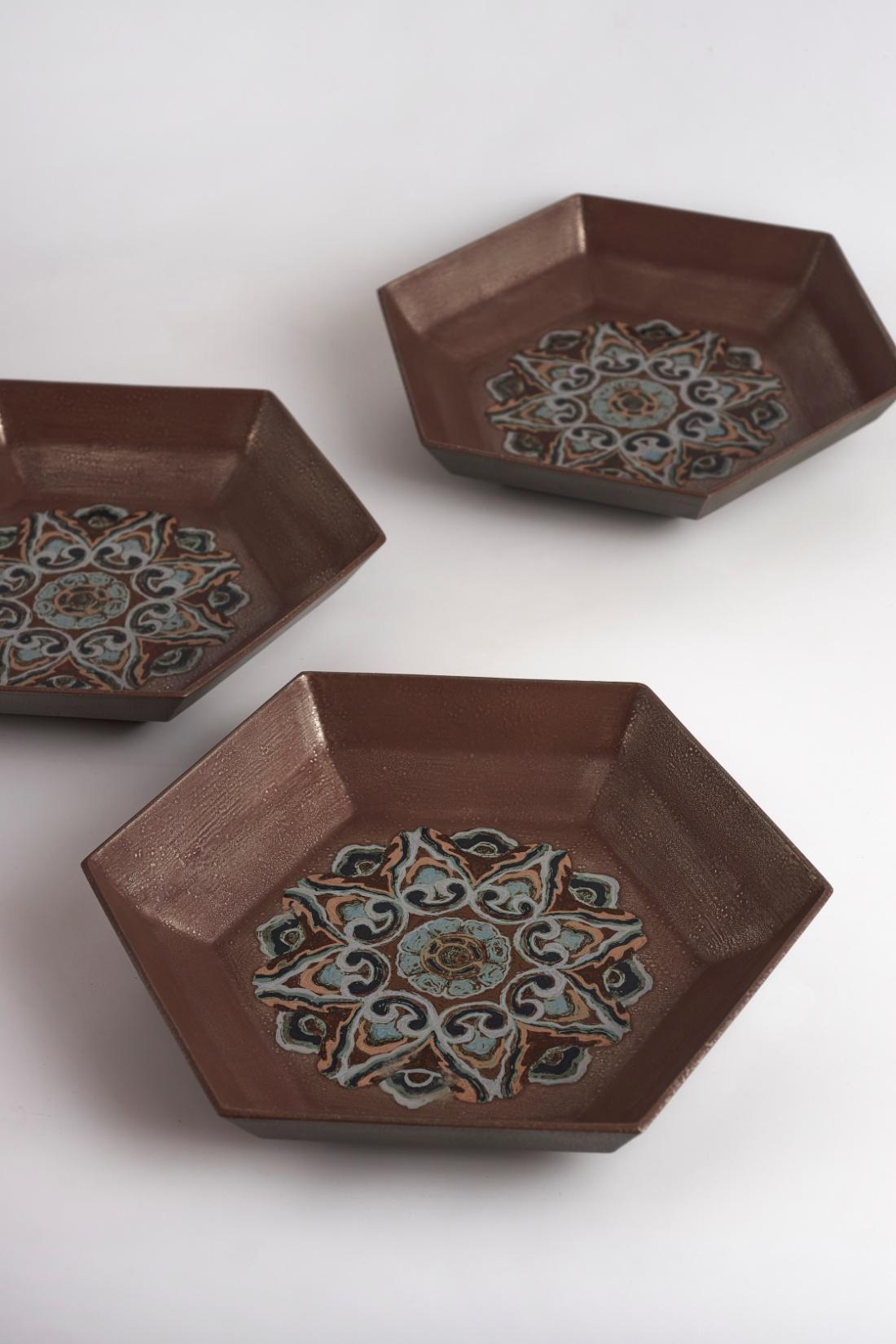
"Dunhuang Mural: Lotus Caisson" — Hand-Painted Hexagonal Lacquer Plate
"Dunhuang Mural: Lotus Caisson" — Hand-Painted Hexagonal Lacquer Plate
Couldn't load pickup availability
Dunhuang Mural: Lotus Caisson — Hand-Painted Hexagonal Lacquer Plate
The lotus has always occupied the centre of Buddhist sacred space — a symbol of purity rising from still water, of beauty that asks for nothing. In the caisson ceilings of the Dunhuang Mogao Caves, the lotus motif radiates outward in concentric rings of colour and geometry, a composition that has endured for over a thousand years without fading.
This hexagonal lacquer plate renders that composition in three dimensions. Handcrafted by YQ Lacquer in Guangzhou using natural lacquer and tin powder over a paper and linen body, the design is built up through slow, layered application — a process that cannot be rushed and cannot be replicated by machine. At H40 × Ø250mm, the depth of the hexagonal form gives the piece a sculptural presence that a flat plate cannot achieve. It works as a wall piece, a display object on a stand, or a centrepiece that anchors a room.
Specifications
- Material: Natural lacquer, paper, tile ash, tin powder, linen fabric
- Construction: Paper body lacquerware — natural lacquer built over layers of paper and linen fabric
- Dimensions: H40 × Ø250mm
- Form: Hexagonal — sculptural depth that distinguishes this piece from flat lacquer work
- Motif: Lotus caisson — inspired by the ceiling paintings of the Dunhuang Mogao Caves, UNESCO World Heritage Site
- Origin: Handcrafted by YQ Lacquer (乙漆), Guangzhou, China
- Edition: Each piece is unique — variations in colour and surface are inherent to the craft
Care
- Avoid prolonged direct sunlight to preserve lacquer colour depth
- Wipe clean with a soft, dry cloth — do not use water or chemical cleaners
- Store away from extreme heat or humidity
- Handle with care — natural lacquer surfaces can be sensitive to sharp impact
The variations in lacquer depth, colour warmth, and tin powder distribution are not inconsistencies — they are the evidence of a hand at work, and what makes each piece irreplaceable.
Share